
401k Retirement Architect
Goal-based planning · IRS limits · Catch-up contributions · Monthly income forecast
401k Calculator: Estimate Your Retirement Savings and Maximize Your Benefits
Planning for retirement can feel overwhelming, but a 401k calculator simplifies the process. This tool allows you to estimate your future 401k balance projection based on salary, contributions, employer match, and investment returns. Whether you want to plan your retirement income or figure out the future value of 401k, using a calculator can help you make informed decisions. By understanding the impact of salary contribution percentage, annual contribution limits, and IRS 401k Calculator limits 2026, you can create a solid retirement savings strategy that grows with your income over time.
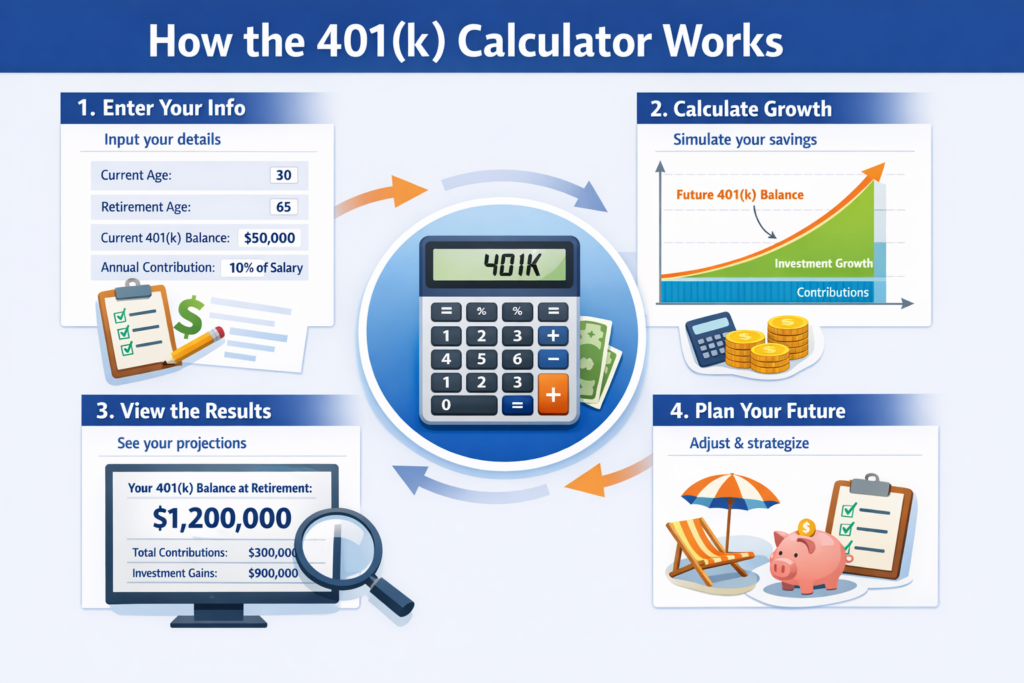
With the right tool, you can see how your money grows through compound interest growth and inflation-adjusted returns. It also helps you evaluate the benefits of different types of plans, including traditional 401k vs Roth 401k and self-directed 401k. For a deeper understanding, you can explore online calculators such as Calculator.net or Bankrate.
Use More Tools
What Is a 401k Calculator and How Does It Work?
A 401k retirement calculator is a powerful retirement planning tool that estimates how much you could have in your 401(k) by retirement. It uses inputs like your current age, salary contribution percentage, current 401(k) balance, and investment return rate to generate a retirement income estimation. Essentially, it allows you to project how your contributions, combined with employer match calculator data, grow over time with tax-deferred retirement plan benefits.
The calculator also considers pre-tax contributions versus after-tax contributions, helping you decide whether a traditional 401k vs Roth 401k makes more sense for your situation. You can also simulate scenarios like calculate retirement savings at age 65 or the impact of inflation on retirement, which allows you to adjust your retirement savings strategy for the future. Online tools such as Bonvenu Bank make this process interactive and easy to understand.
How to Use a 401k Calculator (Step-by-Step)
To use a 401k growth calculator, start by entering your current age, expected retirement age, and current 401(k) balance. Next, input your salary contribution percentage and any expected salary increase over time. Add your employer match details to maximize your benefits using an employer match calculator, and finally, choose an expected investment return rate. Hitting calculate provides a 401k balance projection that shows how much your account could grow by retirement.
It is also helpful to experiment with different best 401k contribution percentage scenarios. For example, small changes in contribution can dramatically affect your final balance due to compound interest growth. This approach allows you to answer questions like how much should I contribute to 401k and understand the long-term investment growth of your retirement account. Tools like Bankrate 401(k) Calculator make this exploration simple and visually clear.
Key Factors That Impact Your 401k Calculator Growth
Several key factors determine your 401(k) growth. Your salary contribution percentage, employer match, and how long your funds remain invested are the primary drivers. Investment return rate and the type of investments, such as mutual funds in 401k, index funds retirement, or ETF investment options, also significantly influence your 401k growth calculator results. Even small changes in returns over decades can lead to major differences in your final balance.
Another important factor is inflation-adjusted returns. If your portfolio grows slower than inflation, your money loses purchasing power. Regularly reviewing future value of 401k and adjusting contributions ensures your retirement plan keeps pace with rising costs. Incorporating these factors makes the retirement savings calculator an invaluable tool for creating a realistic retirement income planning strategy.
Estimate Your Retirement Savings with a 401k Calculator
Using a 401k calculator, you can estimate your retirement savings under various scenarios. For example, a 45-year-old contributing 10% of a $75,000 salary with a 50% employer match could see significant growth by age 65. The tool can simulate low, average, and high returns, showing how long-term investment growth impacts your retirement funds.
| Scenario | Expected Annual Return | Projected 401k Balance at 65 |
|---|---|---|
| Low | 4% | $220,000 |
| Average | 6% | $310,000 |
| High | 8% | $420,000 |
These projections help answer questions like how to calculate 401k growth or how much will my 401k pay me per month calculator, giving you a clear path to plan your retirement income effectively.
Real-life example
Consider Sarah, age 35, earning $80,000 annually and contributing 12% to her 401(k) with a 50% employer match up to 6%. Using a 401(k) retirement calculator, she discovers her future value of 401k at age 65 could exceed $1 million with compound interest growth, highlighting the power of consistent contributions and salary increase over time.
Projection scenarios (low, average, high returns)
By adjusting investment return rates, Sarah can see three potential outcomes. Low returns assume 4%, average returns 6%, and high returns 8%. The difference demonstrates how critical long-term investment growth and portfolio diversification are to her retirement income estimation.
401k Calculator Employer Match Explained (Maximize Your Benefits)
An employer match calculator shows how matching contributions from your employer can significantly increase your retirement savings. If your company matches 50% up to 6% of your salary, contributing the full 6% ensures you capture the maximum benefit. This is one of the easiest ways to maximize employer match and grow your 401k balance projection quickly.
Understanding how employer match works is essential because failing to contribute enough means leaving “free money” on the table. Using a 401k contribution calculator, you can optimize your contributions to balance personal finances with the employer match, improving your retirement income planning and overall retirement savings strategy.
401k Calculator Early Withdrawal Costs and Penalties
Early 401(k) withdrawals come with early withdrawal penalty and 401k tax implications. Generally, withdrawing before age 59½ triggers a 10% penalty plus taxes. There are exceptions, including hardship withdrawals for medical expenses, first-time home purchase, or disability. A 401k withdrawal calculator can help you understand the true cost of pulling funds early.
For example, withdrawing $10,000 early may reduce your retirement balance by more than $15,000 when accounting for lost compound interest growth, taxes, and penalties. Learning how to avoid 401k penalties ensures your retirement distributions remain intact for your future needs.
Taxes + penalties
Early withdrawals are subject to federal, state, and sometimes local taxes. Understanding the tax bracket in retirement is key to calculating potential losses accurately.
Kab allowed hota hai
Withdrawals are allowed in cases like disability, age 55+, or hardship withdrawal rules.
Calculator angle (impact on savings)
Using a 401k growth calculator, you can simulate how withdrawing early affects future value of 401k, helping you plan better.
Types of 401k Calculator Plans (Traditional vs Roth vs Self-Directed)
Choosing the right plan type affects taxes, withdrawals, and investment flexibility. Traditional 401k vs Roth 401k differ mainly in timing of taxation. Traditional contributions are pre-tax contributions and taxed upon withdrawal, while Roth contributions are after-tax contributions, allowing tax-free retirement distributions.
A self-directed 401k provides greater investment flexibility, including real estate, precious metals, and personal loans. Combining knowledge of defined contribution plan rules and employer-sponsored retirement plan options ensures your retirement savings strategy aligns with your long-term goals. Tools like Citizens Bank Calculator can help compare these options.
Traditional 401(k)
Traditional 401(k) contributions reduce taxable income today and benefit from tax-deferred retirement plan growth. Ideal if you expect a lower tax bracket in retirement.
Roth 401(k)
Roth 401(k) allows after-tax contributions for tax-free retirement distributions, helpful for long-term retirement income planning.
Self-directed 401(k)
These plans give control over portfolio diversification, including target retirement funds, ETFs, or alternative investments. They are perfect for investors who want full flexibility.
Investment Options in a 401k Calculator
401(k) accounts offer investments such as mutual funds in 401k, index funds retirement, and ETF investment options. Understanding risk vs return is essential. Stocks may offer higher growth but are volatile, while bonds provide stability. Using target retirement funds simplifies allocation for retirement age planning.
Proper portfolio diversification ensures your retirement grows steadily. A 401k growth calculator can simulate compound interest growth and long-term investment growth, giving you confidence in your retirement savings strategy.
Pros and Cons of a 401k Calculator Plan
A 401(k) provides tax-deferred retirement plan growth, high annual contribution limits, and employer match benefits. It also offers creditor protection, making it a safe retirement savings tool. However, limited investment options, fees, and early withdrawal penalty are challenges. Understanding both sides ensures a smarter retirement income planning strategy.
Required Minimum Distributions (RMDs) and Retirement Withdrawals
When you reach 73, required minimum distributions (RMD) are mandatory. Missing them can incur a 50% penalty. Options include lump sum vs installments, IRA rollovers, or annuities to optimize withdrawals. A 401k withdrawal calculator can help estimate monthly retirement income and plan retirement distributions efficiently.
Proper planning helps answer when can I withdraw 401k questions and ensures your tax bracket in retirement remains optimal. Considering life expectancy calculation and retirement age planning allows better retirement income planning and ensures your savings last.